The Egg and the Hazelnut

This morning I was thinking about two very different images of creation, and a sentence of Simone Weil’s that sits underneath both.

Hildegard of Bingen saw the cosmos as an egg (Scivias I.3): an immense structure of fire, air, water, winds, stars and earth. For Hildegard the physical world discloses a deeper divine order. Creation is not spiritually empty. It speaks to us of God, Christ, the Church, good and evil, judgement and redemption, with Christ at its radiant centre. I was particularly struck by her image of the Church as the moon, reflecting Christ’s light.

Julian of Norwich, writing more than two centuries later, saw something much smaller: a little thing in the palm of her hand, “the quantity of an hazel-nut”. She was told: “It is all that is made.” It seemed so fragile that she wondered why it did not fall into nothing. The answer she received was that “it lasteth … for that God loveth it”.

Both women saw creation as held within God. What differs is scale and posture. Hildegard looks outwards at a cosmos saturated with meaning. Julian looks down at something small enough to hold, and asks why it does not simply vanish.

Weil helps me see why it should be fragile. She understands creation as an act of divine restraint: in making something other than himself, God makes room for freedom and otherness. Creation is an act of love because God does not continually overwhelm it with divine power. As Weil says, “God is good before he is powerful” (Gravity and Grace), the order matters. The question then becomes how that power is revealed and exercised within creation.

Julian also says, “I saw no wrath but on man’s part.” She neither denies the terrible reality of sin and suffering nor pretends to understand how everything will finally be healed. She was assured that “all shall be well”, but the final working out of God’s love remained hidden from her.

The cross has become central to how I understand divine power. It does not explain suffering, or make it good. It does show God present within it: not directing events from outside, but accepting vulnerability and bearing its wounds alongside us.
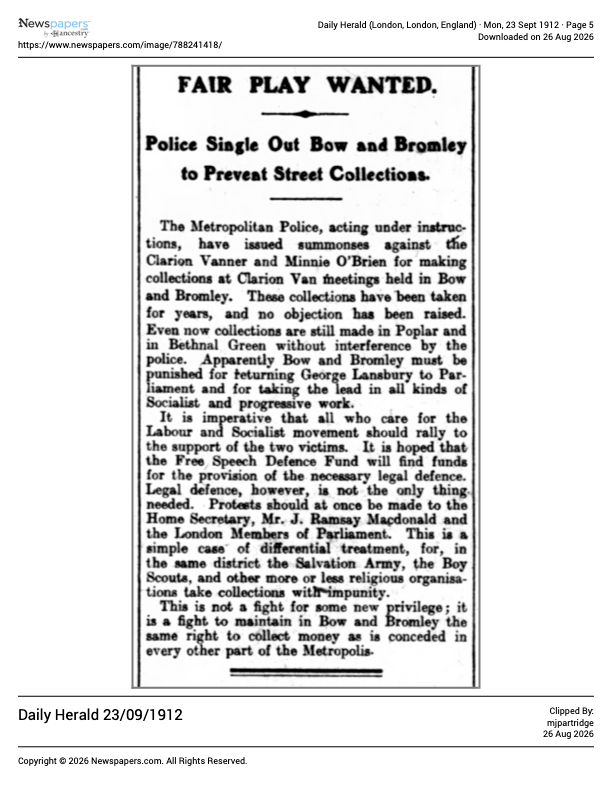
A summons in Bow, September 1912

This week’s family-history discovery was a short item in the Daily Herald of Monday 23 September 1912. The paper was then only five months old. Its piece was headed “Fair Play Wanted: Police Single Out Bow and Bromley to Prevent Street Collections”, and reported that the Metropolitan Police had issued summonses “against the Clarion Vanner and Minnie O’Brien for making collections at Clarion Van meetings held in Bow and Bromley”.

Minnie O’Brien was my grandmother’s sister. Her close connections with George Lansbury are well recorded, including her letter to him of 27 November 1912 in the Lansbury archive. She later figured in street collections for Sylvia Pankhurst and the East London Suffragettes. The Herald also distinguishes “the Clarion Vanner”, whose name it does not give, from “Minnie O’Brien”, who is named in full. The vanner was the Committee’s travelling organiser. This may suggest that Minnie was a local person, sufficiently known in Bow to be identified by name alone.

The paper said that collections had been taken at such meetings for years without objection, and were still being taken in Poplar and Bethnal Green. It argued that Bow and Bromley were being singled out because they had returned George Lansbury to Parliament and were prominent in socialist and progressive work. The Salvation Army and the Boy Scouts, it added, collected in the same district without interference. The Herald appealed to the Free Speech Defence Fund to help meet the cost of a defence.

The case also appeared independently in Hansard. On 9 October 1912, shortly after resigning his seat to fight the by-election on women’s suffrage, Lansbury asked the Home Secretary about “the prosecution of Mr. Ebury and Miss O’Brien for taking collections in the streets of Bow and Bromley at meetings held under the auspices of the ‘Clarion’ Van Committee”. Reginald McKenna replied that a regulation under the Metropolitan Streets Act 1903 prohibited collections in the carriageway, but allowed them on the footway where they caused neither obstruction nor annoyance. He said that the defendants had continued after repeated police warnings. The Hansard page appears to say that Ebury was fined after refusing an undertaking, while Miss O’Brien was discharged on payment of costs after giving one.

A cruciform theology

Recently, I have been asked why having a cruciform theology is so important for me and I struggled to convey clearly what I meant by the phrase. So, I decided to give it some serious thought and here is the result. You can probably see how it ties in with other things I have been sharing recently. 

I sometimes talk about having a cruciform view of Christianity, but I have found this is a phrase that often confuses people including many Christians. It comes from Martin Luther’s Heidelberg Disputation of 1518, in which he contrasts a theology of glory with a theology of the cross. For me, it has become a shorthand for a radically different understanding of God, but it needs unpacking to be meaningful to others.

A theology of glory begins in the obvious places: success, visible power and rescue from above expecting that God will answer our prayers by intervening at the last moment. This is the deus ex machina, the god lowered onto the stage from outside to resolve a plot the writer cannot. A theology of the cross looks where we would least expect to find God: at a man being executed. It says that this is where God is most clearly revealed.

Luther’s twentieth thesis describes the theologian of the cross as comprehending “the visible and manifest things of God seen through suffering and the cross”. The next thesis is blunter: “A theologian of glory calls evil good and good evil. A theologian of the cross calls the thing what it is.” This means experiencing reality as it is, not how I would like it to be, including the shadows and pain from which none of us can fully escape. It means discovering that God has been there with us all along.

I say God, but I could just as readily say Jesus, because Jesus shows me what God is like. To put it another way God is like everything we see in Jesus and more. There is no good cop and bad cop here. Richard Bauckham, writing about Jürgen Moltmann, puts this better than I can: God “not only reveals himself and the world’s future in the contradiction of cross and resurrection, but himself suffers that contradiction in solidarity with the world”. (Richard Bauckham, Moltmann: Messianic Theology in the Making. 57)

In the aftermath of the Second World War, and in the face of the Holocaust, a number of theologians began to speak more urgently of the suffering God. Karl Barth suggests that God’s divinity is seen most clearly in the lowliness of the cross. But Simone Weil had already found her way to something close to this from inside the Catholic tradition while the war was still going on, at much the same time as Dietrich Bonhoeffer was finding it in a prison cell: God hidden, God self-emptied, whatever victory there is coming through weakness and apparent defeat rather than through the forms of domination we instinctively mistake for power.

The cross is therefore the decisive revelation of who God is. I have come to believe that, if the Gospel cannot be spoken truthfully even at the gates of Auschwitz, then it cannot honestly be preached anywhere. For me, this makes the cross more than one Christian doctrine among others. It becomes the way I read Scripture and test what I say about God. The crucified Christ is the lens through which every claim about divine power, judgement and love must pass. 

A cruciform theology is the ultimate deconstructor. It strips away the gods I construct in the image of human power. It still leaves me with questions, though better ones than I had before. The God I am learning to trust is not untouched by the worst that can happen to us but has entered into it. The implications of that I am still learning to understand.

“A Household Inside the Movement: The O’Briens of 106 Cadogan Terrace” (v1.08)

A carefully researched account of the O’Brien family of Bow and their links with East London radicalism, women’s suffrage and socialism. Drawing on archives, family papers and inherited paintings by Sylvia Pankhurst, it traces Minnie O’Brien’s work within Pankhurst’s movement and the family’s connection with George Lansbury, while distinguishing documented evidence from family memory and open questions. This is my major research project at the moment and still very much a work in progress.

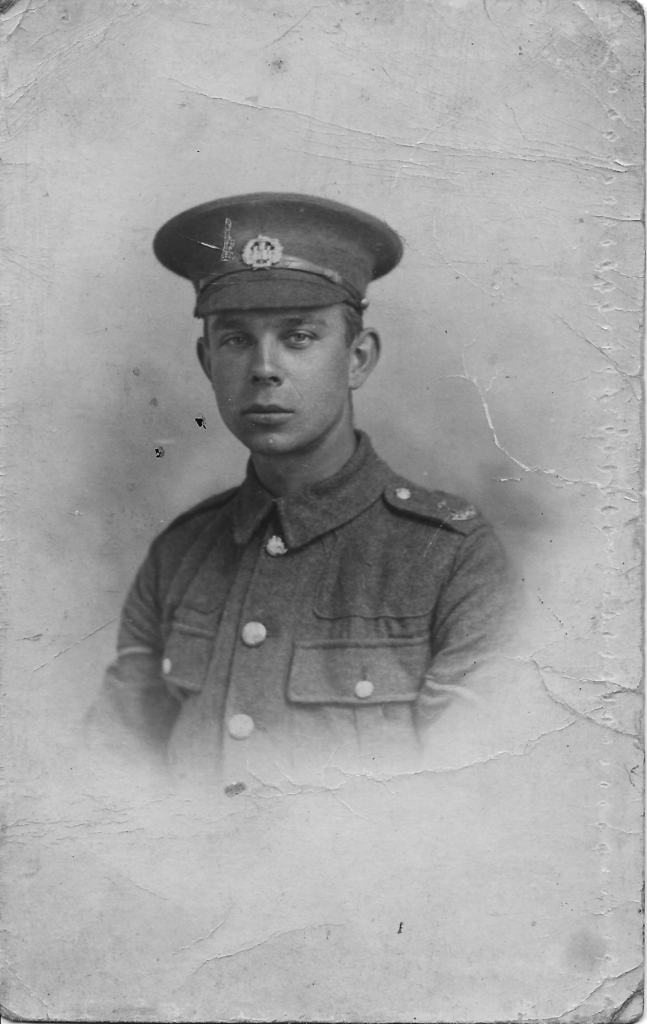
Charles James Partridge

A researched account of my great-uncle Charles James Partridge, a Regular soldier in the Essex Regiment who served in India and South Africa before the First World War. It follows his role in the Gallipoli landings, his wounding at the Second Battle of Krithia, and his death aged twenty-seven in 1915, while placing his brief life within the wider realities of imperial and wartime service.

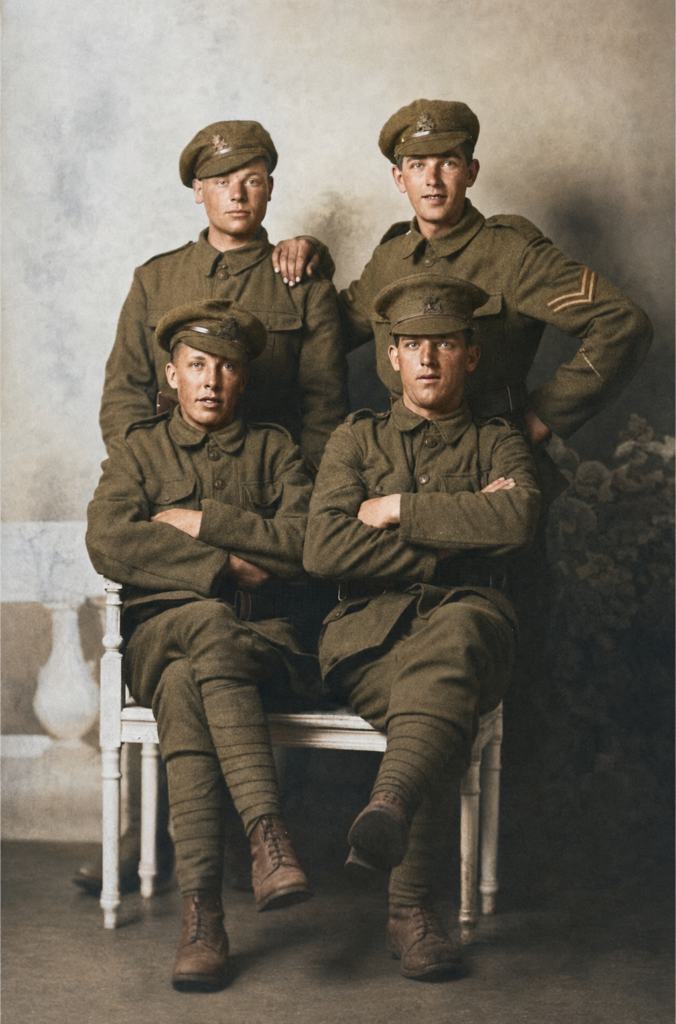
My maternal grandfather in WW1

Charlie Rendell Lavant 1915

A research account of Edward Charles “Charlie” Rendell’s First World War service with the King’s Royal Rifle Corps. It traces his likely enlistment as a teenager, service on the Western Front, capture during the German offensive of March 1918, and imprisonment within the Stendal camp system, while carefully separating established records from informed inference and unresolved questions.

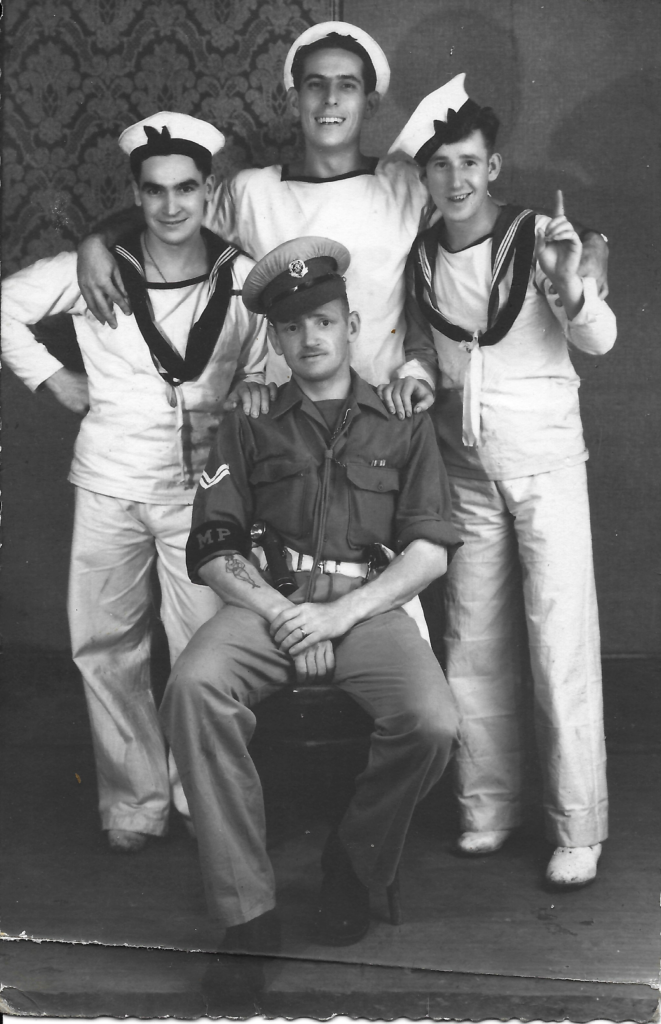
My Father in the Navy

A researched account of my father, Charles James “Jim” Partridge’s Second World War service in the Royal Naval Patrol Service. It follows his survival of the sinking of HMS Mollusc, boom-patrol duty at Scapa Flow, and more than two years aboard the minesweeper HMS Unst in the Mediterranean, while distinguishing firm evidence from family memory and questions still to be resolved.