
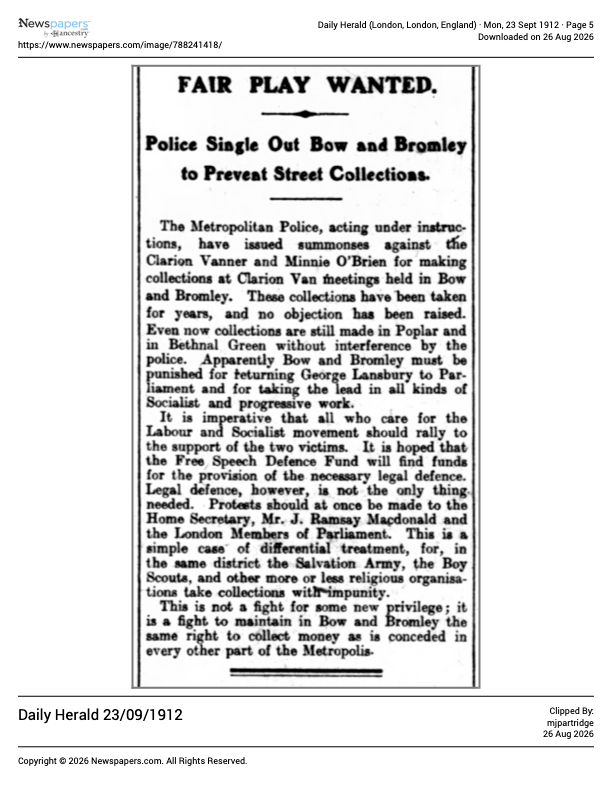
This week’s family-history discovery was a short item in the Daily Herald of Monday 23 September 1912. The paper was then only five months old. Its piece was headed “Fair Play Wanted: Police Single Out Bow and Bromley to Prevent Street Collections”, and reported that the Metropolitan Police had issued summonses “against the Clarion Vanner and Minnie O’Brien for making collections at Clarion Van meetings held in Bow and Bromley”.
Minnie O’Brien was my grandmother’s sister. Her close connections with George Lansbury are well recorded, including her letter to him of 27 November 1912 in the Lansbury archive. She later figured in street collections for Sylvia Pankhurst and the East London Suffragettes. The Herald also distinguishes “the Clarion Vanner”, whose name it does not give, from “Minnie O’Brien”, who is named in full. The vanner was the Committee’s travelling organiser. This may suggest that Minnie was a local person, sufficiently known in Bow to be identified by name alone.
The paper said that collections had been taken at such meetings for years without objection, and were still being taken in Poplar and Bethnal Green. It argued that Bow and Bromley were being singled out because they had returned George Lansbury to Parliament and were prominent in socialist and progressive work. The Salvation Army and the Boy Scouts, it added, collected in the same district without interference. The Herald appealed to the Free Speech Defence Fund to help meet the cost of a defence.
The case also appeared independently in Hansard. On 9 October 1912, shortly after resigning his seat to fight the by-election on women’s suffrage, Lansbury asked the Home Secretary about “the prosecution of Mr. Ebury and Miss O’Brien for taking collections in the streets of Bow and Bromley at meetings held under the auspices of the ‘Clarion’ Van Committee”. Reginald McKenna replied that a regulation under the Metropolitan Streets Act 1903 prohibited collections in the carriageway, but allowed them on the footway where they caused neither obstruction nor annoyance. He said that the defendants had continued after repeated police warnings. The Hansard page appears to say that Ebury was fined after refusing an undertaking, while Miss O’Brien was discharged on payment of costs after giving one.